Suburban Fury: A Conversation with Robinson Devor
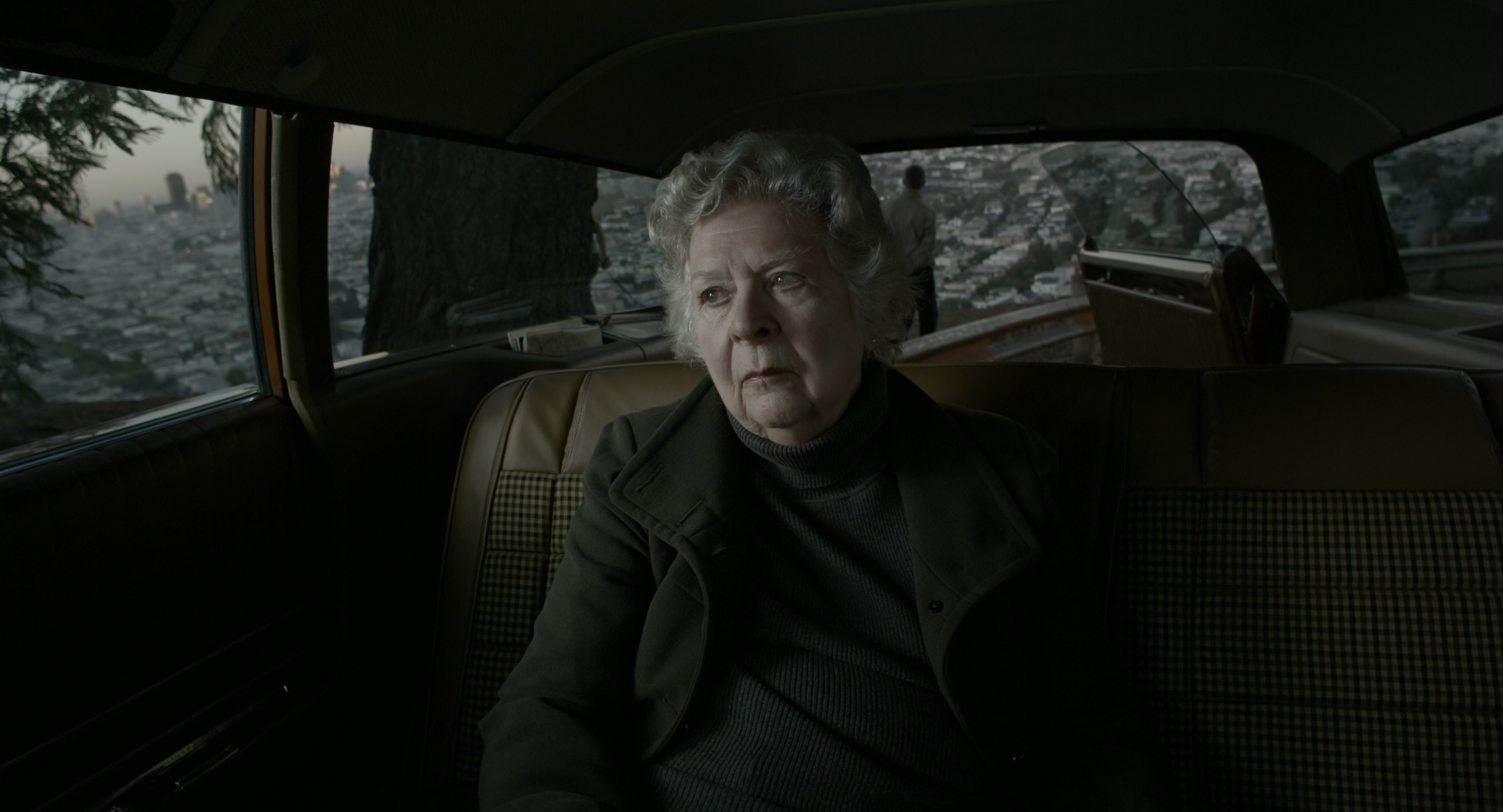
Sara Jane Moore, in Robinson Devor’s Suburban Fury
Suburban Fury: An Interview with Robinson Devor
The evocative title of Robinson Devor’s spellbinding documentary Suburban Fury comes from a simple source; the model names of two popular Plymouth station wagons. The station wagon was the car of choice for undercover FBI agents, allowing them to pass as typical American family men while they went about their covert missions. Suburban Fury, a quietly enthralling portrait of Sara Jane Moore, the suburban mother who attempted to kill President Gerald Ford in San Francisco in September 1975, unfolds like a neo-noir classic as it uses present-day interviews with Moore, haunted landscape and cityscape footage evocative of Edward Hopper’s paintings or James Benning’s films, and a treasure trove of archival material to tell a story that traces Moore’s evolution from aspiring model and actress to divorced single mother to radicalized activist to FBI informant to failed assassin.
Released from prison, but still under Secret Service oversight, Moore agreed to be interviewed by Devor under the unusual condition that she was the only person interviewed in the film. Taciturn and suspicious, and protective of her dubious role in American history, Moore exhibits a distinct undercurrent of irritability throughout the film, as though she is sparring with Devor for control of the story. Devor listens with sympathy, but also with an investigative journalist’s–or a novelist’s–focus on revealing details. In the process, he transforms a deeply intimate portrait film into a much broader American epic. Moore was a Zelig-like figure who had surprising connections to Patty Hearst, and to prisoner rights activist Popeye Jackson, a leader in the movement that emerged after the 1971 Attica riots. In her fascinating journey, Moore became a radicalized feminist, a spurned lover who was routinely betrayed by men, and a conspiracy theorist who was deeply suspicious of the ascent to power of Gerald Ford and vice-president Nelson Rockefeller, who rose to the nation’s highest offices after Richard Nixon’s resignation, without having being elected.
Moore’s story is so interesting that the shooting of Ford somehow feels anticlimactic. When we first see the news footage of the assassination attempt, Devor juxtaposes it with audio of Moore talking about her decision to leave her first husband because she refused to terminate her pregnancy. We are left to draw connections between these two parts of Moore’s life, leading her to a public crime that was also a suicidal act, as Moore expected to be shot to death after killing Ford.
While avoiding the cliches of a typical historical documentary, Devor evokes a time when conspiratorial thinking was taking hold and political violence was commonplace. (Moore’s attempt on Ford’s life took place less than three weeks after Charles Manson protege Lynette “Squeaky” Fromme confronted Ford with what turned out to be an unloaded pistol). Premiering at the New York Film Festival just two months after the assassination attempt on Donald Trump (and days before Sara Moore died), Suburban Fury also speaks very clearly to the fury of our current times. Yet it is a period piece, vividly capturing the particular unease of the mid-1970s. Suburban Fury would make a great companion film with Francis Ford Coppola’s 1974 film The Conversation. In an eerie coincidence, Coppola’s film opens in San Francisco’s Union Square, the site of the hotel where Moore’s assassination attempt took place. The hotel’s name, fittingly, was the St. Francis.
I talked to Devor in early December, just before the film opened theatrically in New York.
Schwartz: In the press notes, you cited Chantal Akerman’s Jeanne Dielman as an important influence. I see that in a number of ways, both in your formal approach, and in the way that the films focus on women who commit seemingly inexplicable violent acts.
Devor: Correct. There are films I’m striving to be influenced by. Certainly the cataclysm of violence, I wasn't even really thinking about that but it's so obvious to me that I'm glad you mentioned it. I just love Akerman so much, and there is a meditative approach to editing. There’s just such a strength to her filmmaking and a sensitivity and patience. [For Suburban Fury] I had to get very centered and honestly open my heart a lot to Sara Jane Moore and what her life might have been like.
How did that relationship develop? She can be hard to read, and there are flashes of anger. But there’s something so compelling about her.
I think that Sarah Jane Moore was really trying to be honest in this film. Can we try to be honest and still lie a little bit to ourselves? Probably. But people have said, and I agree, she wouldn't have been such a great storyteller unless she had perfected these stories over 40 years. Everybody wants their own narrative to remain the way that they want it, and it’s tough when somebody shifts a little bit and challenges someone. You were asking about her as a personality or a person and I'm not sure. I still have so many mixed feelings, to be honest.
It was an interesting choice of title, Suburban Fury. We do really come to understand a woman who starts as a model and actress, sort of trading on her beauty, and then she becomes disenchanted with society and has a marriage that doesn’t work, and she becomes radicalized against suburban normality. But that still doesn’t quite explain why she would want to kill Gerald Ford.
Killing Ford for her, was synonymous with copying a bunch of pamphlets in some way. It was her way of volunteering. I think her lack of empathy relegated that attempted murder into a task. And you also have to remember that the culture of violence that she was living in was very normal. The FBI and the right and the left were acting in extremely violent ways. As for “suburban fury,” it's just a little joke. I must say titles are always so tough. The real truth is that we were doing some research and trying to figure out what kind of station wagon she was in. It was a Satellite, but there was a Suburban station wagon and there was a Fury in those days. And we just combined the names of the station wagons, to be honest.
It works.
Yeah. The thing about that station wagon that is interesting is that that is not supposed to be her car. She drove a Toyota Corolla. She's one of the first people to to drive a foreign car in her neighborhood. The station wagon was the FBI’s car; the FBI would drive them to appear normal, so I guess there’s a veneer of normalcy that is what that’s supposed to be all about.
I saw the film last year at the New York Film Festival, before the election. And seeing it again recently, now that we’re many months into this presidency, the film feels so much more timely today because of the political divide and the fury that everybody seems to be feeling now.
It is interesting how similar this all is to 50 years ago. Conspiracy theories were lurking in those days. Even Sara Jane with her thinking, if I assassinated Ford, Rockefeller would be president, and then there would be a big uprising…there’s a lot of theories about cabals and all that stuff, which I’m not saying doesn’t have some truth to it, but it’s amazing how many things you could piece together that are reflections of today.
I appreciated how you avoided cliches in depicting the time period.
That’s a shout-out to everyone who worked on the film and that was definitely a mandate. Maybe a few of the Black Panther shots are iconic, but very few, just because there’s not that many shots of the Black Panthers in those days. One of my partners was in San Francisco at the time and he said we have to end this film by going to black, and you crank “Volunteers of America” by Jefferson Airplane. And I said “I don’t think I can do that.” We tried it; the song is so good that I lived with it for a day, and then it didn’t come up again.
So what were some of the choices you made along the way? Obviously the first key was to only have one interview in the film. Which makes it a real character study. The film becomes broader, somehow, by focusing on just one person.
I try to mix things up in my films. One film that I did had no talking heads, and the documentary was all recreations. Another documentary I made had multiple people speaking. And I thought this was a good opportunity to really let Sara Jane have an in-depth exploration of herself and her actions. You know, I’m always so influenced by Errol Morris’s The Fog of War. That just always stays with me. You could say you're missing another perspective. But as they say, someone can hang themselves if that's the way it's going to go. So that's what we went with. And I think because Sara Jane Moore had had some very tough time with journalists in those days, she was looking for somebody who would give her the platform. And it was very tempting–there were people we wanted to hear from that we didn't include in the film. A lot of people didn't even want to talk about her because they thought she was a liar and a nut. So it's just as well, probably.
She even says that she's being careful, like that she's being honest on one hand, but on the other hand she has things she will not tell you and she’s open about that in a way that allows you to question everything she says.
I think you have to consider the fact that this film was approved by the Secret Service. This is where the conspiracy theories get kind of juicy. These are files that have been sealed to this day. We were not able to get any of the voluminous reports she did as an informant. There are things regarding Popeye’s death, for instance, and other things that some very astute reporters like those in the Berkeley Barb piece together. As you can tell, after all these years, I feel her loyalties lie more with the FBI than with radicals. I think she was a stout feminist and her politics vacillated in different areas, but I feel that there was a great respect and loyalty and that in fact might even be a part of some conditioning from her time there.
It was striking to me that the first thing she says in the film is “I think I was in a fugue state.” Like she was in a dream, and almost didn’t have control of her actions. That hung over the whole film for me.
Well, I hope that's a good 1970s trope. [Laughs] The remote control. I think that had reference to the way she was under so much pressure from the right and the left and she was essentially moving towards self-annihilation…I think she thought she was going to be killed when she took that shot.
And how did you develop the voiceover of the FBI agent “Bertram Worthington.”
Bert Worthington was somebody that she spoke about all the time. “Bert said this” and “I asked Bert this” and “We had lunch here” and "We did this here” and “I called him for this.” So he was a very big part of the interviews, you know, coming in and out all the time. Of course, there was no Bert Worthington. There was no reference to him at all after 1975. And by doing some research into the way informants and their control agents are handled, all of these guys have a cover identity. And so does an informant. She has a code name and a cover identity as well. Those are things we could have found out if we'd gotten access to the files.
We did find two key documents that allowed us to do this. One was a very long list of control agents and informants. The informants were code names on one hand. This was in San Francisco as well. And then there was a list of agents in control. And for the agents, all their names were ridiculously regal upper middle upper class white names like Carl Spencer, Bertram Worthington, and Harrison Lombard. There was a lack of creativity. They were clearly cover identities.
Since we didn't have any talking heads we needed a little bit of a contrapuntal thing, and Bert was in so many stories, and she would use his dialogue. Like “Bert said to me, I want you to get in the car and drive. That's what you need to do. Get in the car, put your son in the car, and just drive.” And you see her saying that story at the end, saying what Bert said, and you hear Bert at the beginning, saying those words as my own voiceover. So we're trying to give the viewer a bit of clue there as to the means of, it's subtle, but that's the way we did it. We transcribed her conversations about Bert. There were maybe one or two things that we took from research. But the second document that we found, it was the last document we found. It was kind of amazing. It was a document looking into her assassination attempt and the means of her recruitment. And the relationship between her and Bert Worthington. And as you could hear at the end, she said, she was more interested in shooting and killing Bert than the president because of the way her feelings had been warped, thinking that she was close to this person.
That's like every relationship with a man in the film. She has a failed marriage, she thinks she’s close to Popeye. This is an aspect of the film that the film is a feminist portrayal of a woman in a world where man are constantly deceiving her.
All of my favorite poets and so many of my favorite filmmakers are women. I grew up in a pretty conservative background. I saw my mother caught in similar snags and boundaries and things like that. So I'm drawn to that. Nina Menkes is one of my all-time favorites filmmakers. I read a lot of Anne Sexton when I was younger. I try to be sensitive to that as best I can. It's not my role; I'm very aware that I'm a man who made this film about Sara Jane Moore. I would say, she, she did ask me to do it, she was open to it. There were other women who interviewed her that I know she was not happy with. So that's the way that's the way the chips fell.
She died just a few months ago, but I'm assuming she saw the film and was just wondering how she felt.
She never saw the film. Which is crazy because we had been emailing over the years. The film got into the New York Film Festival. We found out probably in July of 2024. My email to her prior to that had been probably in February. She said, will I ever get to see the film? I said, yes, it's very close. Hang in there. And we were moving towards submitting and things like that. Then when we found out we got in, we said we have to make a plan. We're going to either have to go down and show it to her or invite her to New York. New York was not interested in having her attend because they thought it would maybe distract a little bit. But we sent all these messages and we did not hear anything. She was on television in July of 2024 after the assassination attempt on Trump. She was in a hospital bed, and some reporter found her in Tennessee. I did not know she was living there. And she didn't look well, but she was happy to talk about political violence and her attempt on the president. So it was even stranger that she did not get back to me. I never heard back from her. tried her again a couple times, and then we heard recently that she passed away.
The Patty Hearst story is so important and parallels her story in such an interesting way. And then, of course, she has this weird connection to Hearst that was amazing. you know
Patty Hearst was probably so powerful a story and an enthralling story that I know Sara Jane, actually she told me that she was the only one that she knew of that had all of Patty's communiques typed out and bound in little pamphlets and she kept it in a box. So she was definitely very into Patty's communiques.
That totally makes sense i mean it fits in with this way that she thought about herself.
Maybe I should have gotten that in there.
No, no…the relevance is made very clear. Just one last detail; it’s such a great coincidence that the assassination attempt took place exactly where the opening of Francis Ford Coppola’s The Conversation was filmed.
I watched The Conversation over and over when we were making this film, that's all I was watching. And yeah, that was a beautiful thing to see, to know that the film was shot there, and some of the locations were overlapping. It just makes me bow down to Francis Ford Coppola with the way he shot Union Square with those long telephoto lenses and the way he found a way to get up on the billboards and everything. It's just unbelievable. We wer just a little team.
You have some amazing shots. I mean, there are images in your film that are so striking and you should feel pretty good about that.
Yeah, shout out to our great cinematographers, Sean Kirby and A.J. Lindsay. They really shot San Francisco really well.
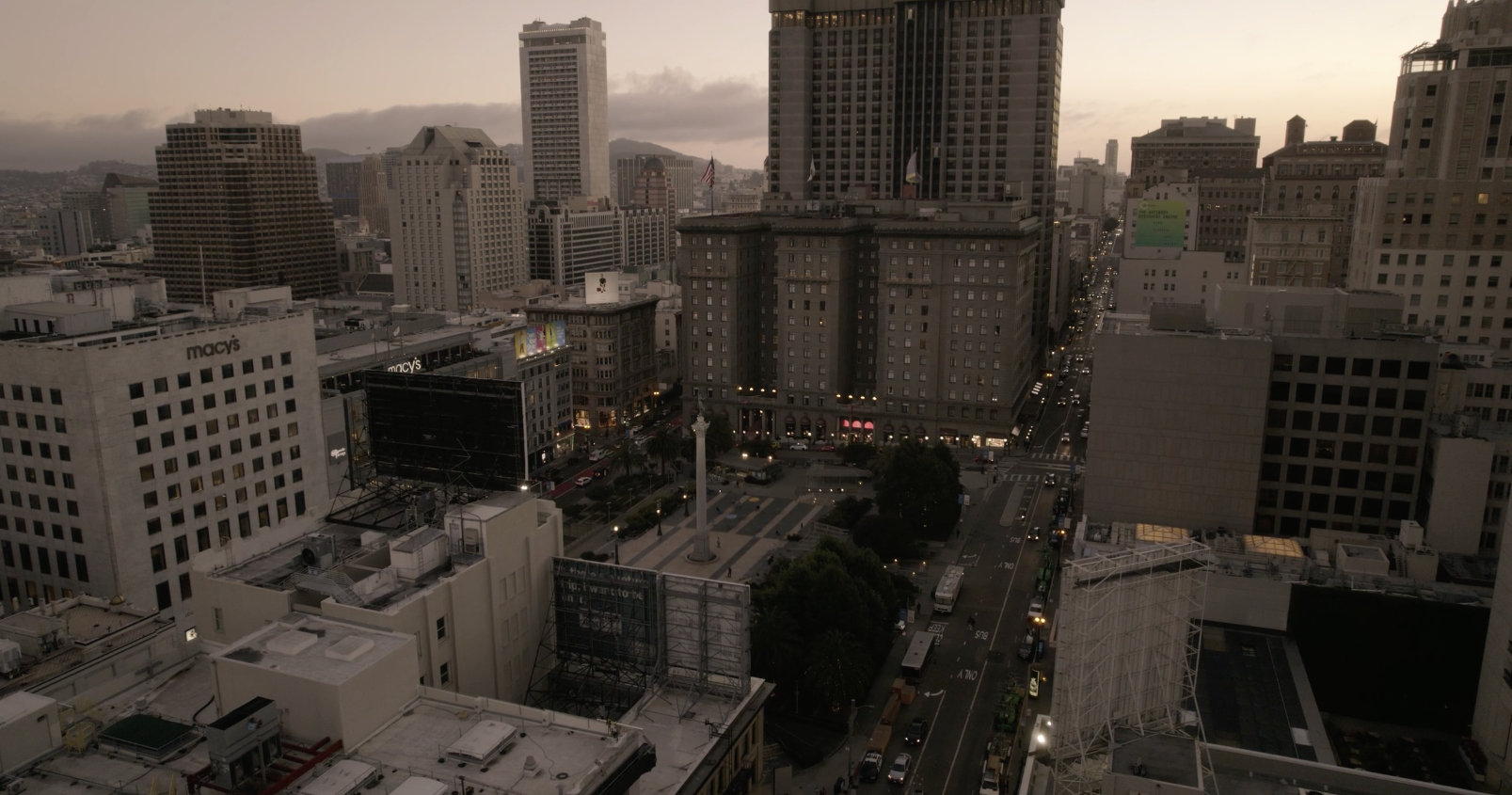
From Suburban Fury. In the foreground, Union Square, the setting for the opening scene in The Conversation. In the background, the St. Francis Hotel (now The Westin St. Francis San Francisco), where Gerald Ford was nearly shot by Sara Jane Moore. Below, two frames from The Conversation.
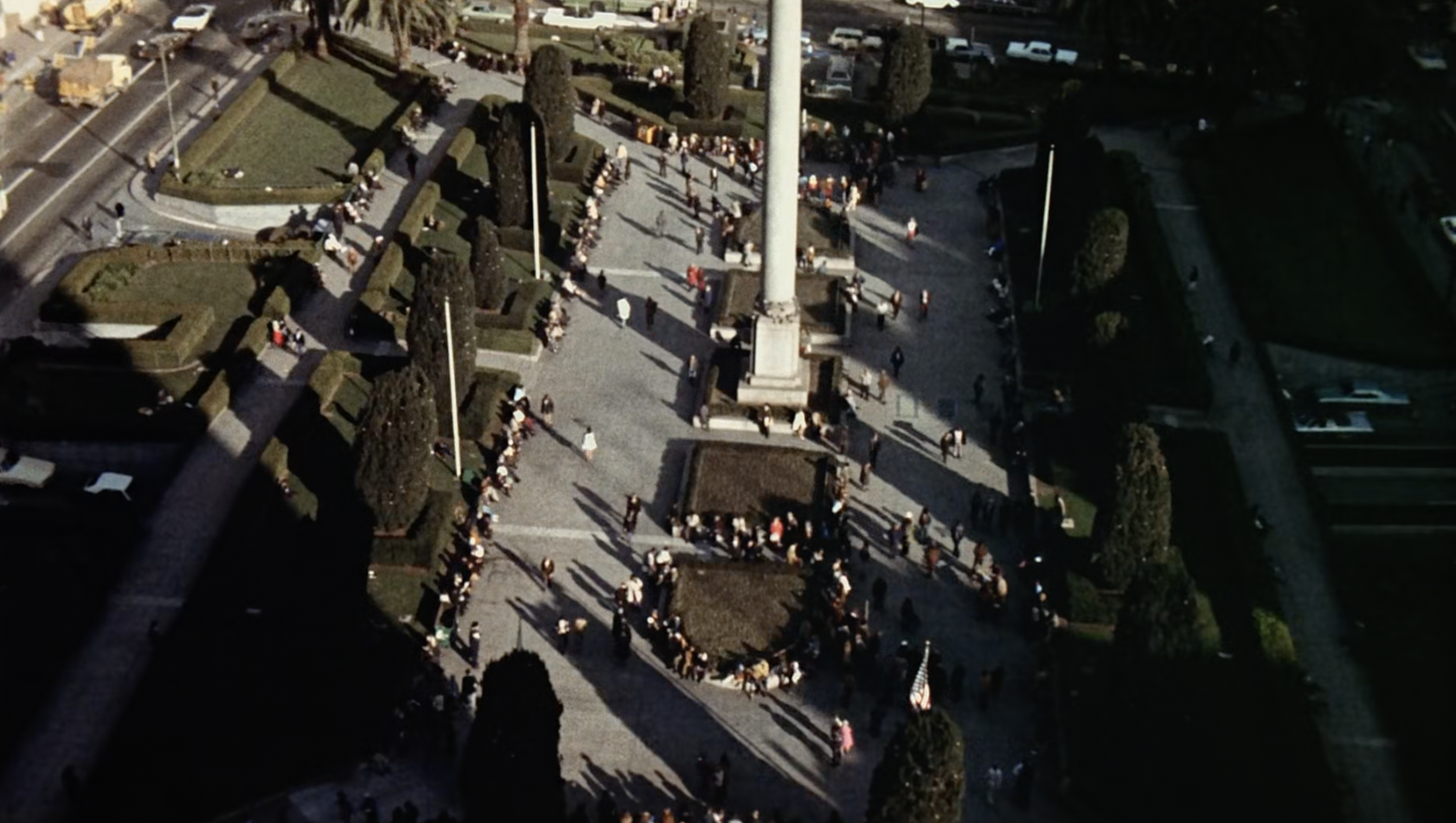
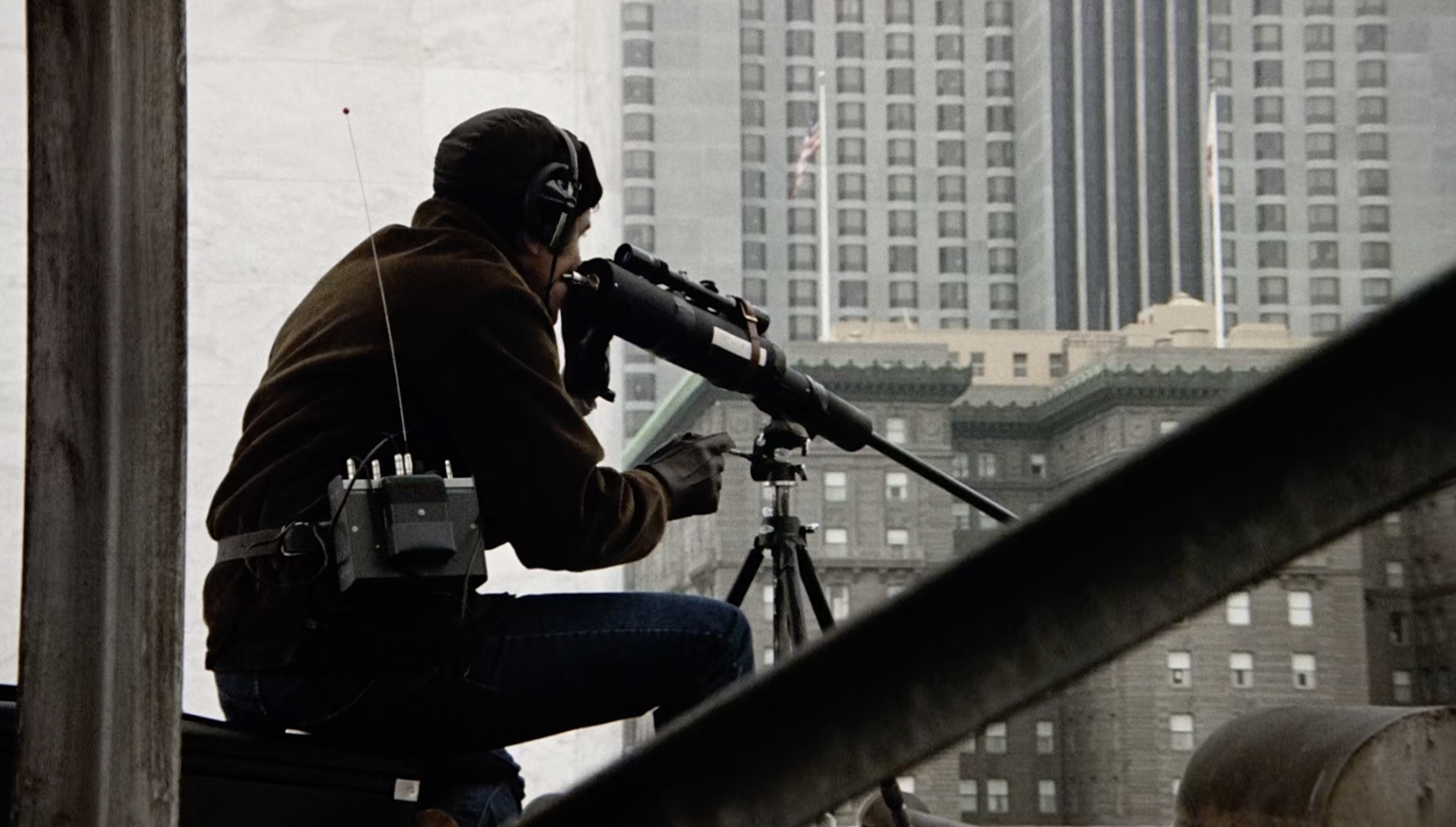
Not a sniper, but a sound recordist with a long-range microphone, from The Conversation. The St. Francis Hotel is in the background.